Premium Recommendation -A Complete Set of Commemorative Stamp No.40 Automobiles
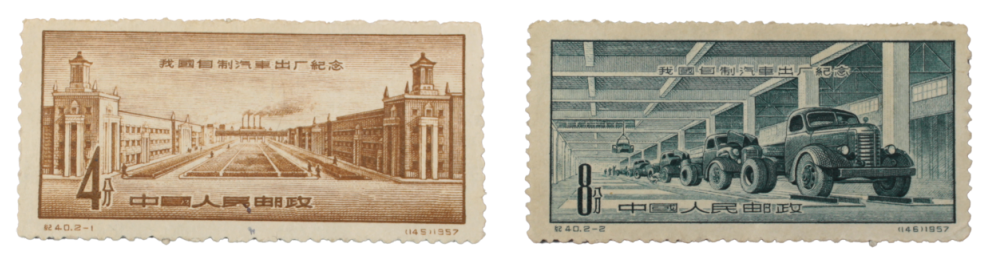
*本次藏品:纪40邮票汽车一套 *
典藏尺寸:23×47mm
1957 年 5 月 1 日,中国邮政发行纪 40《我国自制汽车出厂纪念》邮票一套 2 枚,以方寸之地定格了新中国汽车工业 “从 0 到 1” 的里程碑时刻。这两枚邮票不仅是邮政史上的 “工业题材开山作”,更是 1950 年代中国 “工业化梦想” 的视觉载体 —— 其设计细节、发行背景与收藏轨迹,共同构成了一部微型的 “新中国工业觉醒史”。
纪 40 邮票的发行,与新中国第一辆汽车 “解放 CA10” 的诞生紧密绑定,其背后是一个国家 “工业自立” 的集体渴望。
1949 年新中国成立时,全国汽车年产量不足 100 辆,且均为组装外国零部件的 “万国牌”。1953 年,中央决定在长春建设第一汽车制造厂(以下简称 “一汽”),这是 “一五计划” 156 个重点项目之一,被视为 “新中国工业的心脏”。1956 年 7 月 13 日,第一辆 “解放 CA10” 载货汽车在一汽总装线驶下 —— 这是中国首次完全自主生产的汽车,标志着 “中国不能制造汽车” 的历史被终结。消息传开后,《人民日报》以 “解放了的中国,生产出了自己的汽车” 为题发表社论,“解放牌” 成为国家工业化的精神符号。
为纪念这一事件,邮电部于 1957 年 4 月批准发行纪 40 邮票,由孙传哲设计、北京人民印刷厂营业分厂采用雕刻版印刷,全套 2 枚,面值分别为 4 分、8 分。
On May 1, 1957, China Post issued a set of 2 stamps under the commemorative series No. 40, Commemorating the Roll-off of China's Homemade Automobiles. These tiny postage stamps captured the milestone moment when New China's automobile industry took its historic first step from scratch. More than just the pioneering industrial-themed stamps in the history of Chinese postal service, the two stamps served as a visual embodiment of China’s "industrialization dream" in the 1950s. Their design details, issuance background and collection legacy together compose a microcosm of the awakening of New China’s industry.
The release of Commemorative Stamp No. 40 was closely linked to the birth of the first automobile made in New China—the Jiefang CA10, and behind it lay the collective aspiration of a nation for "industrial independence".
When the People's Republic of China was founded in 1949, the country’s annual automobile output was less than 100 units, all of which were "assorted foreign-brand vehicles" assembled from imported components. In 1953, the Central Government decided to build the First Automobile Works (FAW) in Changchun, which was listed among the 156 key projects of the First Five-Year Plan and hailed as "the heart of New China’s industry". On July 13, 1956, the first Jiefang CA10 truck rolled off the assembly line at FAW—the first fully domestically produced automobile in China, marking the end of the history where "China could not manufacture automobiles". Upon the news, People’s Daily published an editorial titled "Liberated China Produces Its Own Automobiles", and the "Jiefang" brand became a spiritual symbol of national industrialization.
To commemorate this event, the Ministry of Posts and Telecommunications approved the issuance of Commemorative Stamp No. 40 in April 1957. Designed by Sun Chuanzhe and printed by the Business Branch of Beijing People’s Printing Factory using the engraving technique, the complete set consists of 2 stamps with face values of 4 fen and 8 fen respectively.
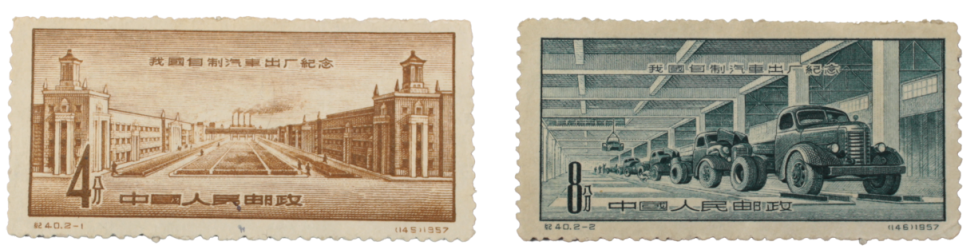
*本次藏品:纪40邮票汽车一套 *
典藏尺寸:23×47mm
纪 40 邮票采用 “场景互补” 的设计思路,2 枚邮票共同构建了 “工业生产的完整链条”:
4 分票:《长春第一汽车制造厂厂房》画面以一汽正门及主厂房为主体,对称的建筑布局、高耸的钟楼、整齐的林荫道,呈现出 “苏联式工业建筑” 的宏大与规整;背景中烟囱冒烟的动力车间,暗示着工厂的生产活力;前景的行人与开阔的广场,传递出 “工业为民” 的时代基调。设计上采用 “暖棕色调 + 精细线雕”,既突出建筑的厚重感,又通过线条的疏密体现空间层次 —— 这是孙传哲 “以建筑写时代” 的典型手法。
8 分票:《总装配线》画面聚焦一汽总装车间:多辆 “解放 CA10” 汽车在流水线上依次排开,车间顶部的吊车、钢结构梁柱,展现出工业化生产的效率与规模;汽车的细节(格栅、轮胎、驾驶室)被精准刻画,体现了 “中国制造” 的技术精度。色调采用 “冷蓝绿 + 深灰对比”,既突出车间的冷静工业氛围,又让汽车成为视觉焦点 —— 这种 “功能与美学结合” 的设计,契合了 1950 年代 “实用主义” 的审美取向。
纪 40 邮票采用的 “雕刻版印刷”,是 1950 年代中国邮政的 “顶级工艺”,其细节的精细度,恰与 “解放牌汽车” 的工业精度形成呼应。
1. 雕刻师的 “毫米级还原”
这套邮票由雕刻师孔绍惠、唐霖坤操刀,他们以 “写实主义” 为原则,将一汽的建筑与汽车细节 “复刻” 到方寸之间:
4 分票的建筑部分:每一根立柱的纹理、钟楼的尖顶装饰、厂房窗户的排列,都通过 “不同密度的线条” 实现 —— 立柱用 “竖线 + 交叉线” 体现石材质感,窗户用 “细线排列” 体现玻璃反光;
8 分票的汽车部分:轮胎的纹路用 “螺旋线” 刻画,车身的金属质感用 “斜线 + 网点” 结合呈现,甚至驾驶室的门把手都有清晰的线条勾勒。
这种 “毫米级还原”,让邮票成为 “解放牌汽车” 与一汽厂房的 “微型档案”,至今仍是研究 1950 年代工业建筑与汽车设计的视觉资料。
2. 印刷工艺的 “时代顶配”
1957 年的中国,雕刻版印刷技术尚处于起步阶段,纪 40 邮票的印刷采用了当时的 “顶配工艺”:
纸张:使用 “有齿孔道林纸”,纸张厚度均匀、吸墨性好,至今保存完好的邮票仍能看到纸张的细腻质感;
油墨:采用 “进口快干油墨”,4 分票的棕色调稳定不褪色,8 分票的蓝绿色则通过 “分层印刷” 实现深浅过渡;
齿孔:使用 “梳式齿孔机” 打孔,齿孔均匀、无粘连,体现了当时印刷工业的标准化水平。
据《中国邮政史》记载,纪 40 邮票的印刷合格率达 98%,远超同期其他邮票的 92%,足见邮电部对这套 “工业纪念邮票” 的重视。
纪 40 邮票并非普通的 “纪念邮品”,而是 1950 年代中国 “工业立国” 战略的 “视觉宣言”,其意义远超邮政范畴。
1. 国家形象的 “工业符号”
在 1950 年代的国际语境中,“能否制造汽车” 是衡量一个国家工业实力的核心标准。纪 40 邮票的发行,是中国向世界宣告 “工业自立” 的方式:
邮票在 1957 年 “五一国际劳动节” 发行,既呼应了 “劳动创造工业” 的主题,也借国际劳动节的传播力,向全球展示中国的工业成就;
邮票被列为 “新中国重点邮品”,通过驻外使馆、国际邮展等渠道流向海外,成为当时中国 “工业进步” 的形象名片。
2. 社会心理的 “集体共鸣”
对于当时的中国民众而言,“解放牌汽车” 是 “美好生活” 的象征,纪 40 邮票则将这种 “集体渴望” 具象化:
邮票发行后,各地邮局出现 “排队购买” 的热潮,北京、上海等城市的邮票在半天内售罄,不少民众将其贴在笔记本上作为 “工业梦想的纪念”;
中小学课本将纪 40 邮票作为 “工业教育” 的素材,邮票上的厂房与汽车,成为一代人对 “工业化中国” 的最初想象。
3. 工业文化的 “传承载体”
纪 40 邮票记录的不仅是 “一辆汽车”,更是新中国第一代工业人的精神:
邮票画面中的 “总装配线”,是一汽工人 “三班倒、连轴转” 的劳动场景缩影 ——1956 年一汽工人平均每天工作 12 小时,用 3 年时间完成了原计划 5 年的建设任务;
邮票的 “解放” 二字,既对应汽车品牌,也暗含 “从农业国解放为工业国” 的时代隐喻,成为新中国工业文化的核心符号之一。
纪 40《我国自制汽车出厂纪念》邮票,是一枚 “有温度的工业文物”:它以雕刻版的线条,记录了新中国第一辆汽车的诞生;以暖棕与蓝绿的色调,定格了 1950 年代的工业梦想,承载了一代人的集体共鸣。
从 1957 年五一劳动节的邮局柜台,到 2025 年的收藏市场,这套邮票的价值早已超越 “邮资凭证”—— 它是新中国工业觉醒的 “视觉标本”,是 “中国制造” 从无到有的 “微型纪念碑”。当我们凝视邮票上的厂房与汽车时,仿佛能听到 1956 年一汽总装线的机器轰鸣,感受到一个国家向工业文明迈进的心跳。
Commemorative Stamp No. 40 adopted a design concept of "scenario complementarity", with the two stamps jointly constructing a "complete chain of industrial production":
4-fen Stamp: Main Factory Building of Changchun First Automobile WorksThe composition centers on the main gate and principal workshop of FAW. Its symmetrical architectural layout, towering clock tower, and neatly arranged tree-lined avenues embody the grandeur and orderliness of Soviet-style industrial architecture. In the background, the power plant with smoking chimneys hints at the factory’s vibrant production activities, while the pedestrians and open square in the foreground convey the era’s underlying theme of "industry serving the people". The design employs a warm brown color palette combined with intricate line engraving, which not only accentuates the architectural solidity but also creates a sense of spatial depth through variations in line density. This stands as a classic example of Sun Chuanzhe’s artistic approach of "depicting the era through architecture".
8-fen Stamp: Final Assembly LineThis stamp focuses on FAW’s final assembly workshop. Multiple Jiefang CA10 trucks are lined up sequentially along the assembly line. The overhead cranes and steel structural beams in the workshop highlight the efficiency and scale of industrialized production. The meticulous rendering of automotive details—such as grilles, tires, and cabs—showcases the technical precision of "Made in China". The color scheme features a contrast between cool blue-green and dark gray, which underscores the workshop’s rational industrial atmosphere while making the vehicles the visual focal point. This design, integrating functionality with aesthetics, aligns perfectly with the pragmatist aesthetic trend prevalent in the 1950s.
The engraving printing technique employed for Commemorative Stamp No. 40 represented the top-tier craftsmanship of China Post in the 1950s. The exquisite detailing of the stamps resonates precisely with the industrial precision embodied by the Jiefang trucks.
1. Millimeter-Level Restoration by Engravers
The stamp set was masterfully engraved by Kong Shaohui and Tang Linkun, who adhered to the principle of realism to replicate the details of FAW’s buildings and automobiles on the tiny stamp surface:
Architectural details on the 4-fen stamp: The texture of every column, the decorative finial of the clock tower, and the arrangement of workshop windows were all rendered through lines of varying densities. Vertical and cross-hatching lines were used to mimic the stone texture of columns, while fine parallel lines conveyed the reflective quality of window glass.
Automotive details on the 8-fen stamp: Tire treads were depicted with spiral lines; the metallic luster of the vehicle body was achieved through a combination of diagonal lines and dot patterns; even the door handles in the cabs were outlined with distinct, clear lines.
This millimeter-level restoration has elevated the stamps to the status of microscopic archives documenting the Jiefang trucks and FAW’s factory buildings. To this day, they remain valuable visual materials for researching 1950s industrial architecture and automotive design.
2. State-of-the-Art Printing Craftsmanship of the Era
In 1957, engraving printing technology in China was still in its infancy, yet Commemorative Stamp No. 40 was produced using the most advanced techniques available at the time:
Paper: Perforated wood-free paper was used, characterized by uniform thickness and excellent ink absorption. Well-preserved specimens of the stamp still retain the paper’s delicate texture to this day.
Ink: Imported quick-drying ink was adopted. The warm brown hue of the 4-fen stamp has remained stable and fade-resistant, while the blue-green color of the 8-fen stamp achieved smooth gradations of light and shade through layered printing.
Perforations: A comb perforator was used to create the stamp perforations, resulting in uniform, clean-cut holes without any adhesion. This attested to the standardized quality of China’s printing industry at that time.
According to A History of China Post, the pass rate of Commemorative Stamp No. 40 reached an impressive 98%, far exceeding the 92% average of other stamps issued during the same period. This statistic fully reflects the Ministry of Posts and Telecommunications’ great emphasis on this set of industrial commemorative stamps.
Commemorative Stamp No. 40 is far more than a mere commemorative philatelic item; it serves as a visual manifesto of China’s "industrialization for national development" strategy in the 1950s, its significance extending well beyond the realm of postal services.
1. An Industrial Symbol of National Image
In the international context of the 1950s, the ability to manufacture automobiles was a core benchmark for measuring a country’s industrial strength. The issuance of Commemorative Stamp No. 40 was China’s way of declaring its industrial independence to the world:
Released on International Workers’ Day in 1957, the stamp not only echoed the theme of "industry forged by labor" but also leveraged the global visibility of the holiday to showcase China’s industrial achievements to the world.
Classified as a key philatelic item of New China, the stamp was circulated overseas through channels such as Chinese embassies abroad and international philatelic exhibitions, serving as a cultural calling card that represented China’s industrial progress at the time.
2. A Collective Resonance in Social Psychology
For the Chinese people in that era, the Jiefang truck was a symbol of a better life, and Commemorative Stamp No. 40 materialized this collective aspiration:
Following its release, a nationwide craze ensued, with long queues forming at post offices across the country. In major cities like Beijing and Shanghai, the stamps sold out within half a day. Many people pasted the stamps in their notebooks as mementos of their industrial dreams.
The stamp was incorporated into primary and secondary school textbooks as educational material for industrial literacy. The factory buildings and trucks depicted on the stamps became the formative image of an "industrialized China" for an entire generation.
3. A Carrier of Industrial Cultural Heritage
Commemorative Stamp No. 40 does not merely document the production of a single vehicle; it encapsulates the spirit of New China’s first generation of industrial workers:
The final assembly line portrayed on the stamp epitomizes the arduous work ethic of FAW’s laborers, who worked round-the-clock in three shifts. In 1956, FAW workers put in an average of 12 hours of work per day, completing a construction project originally scheduled for five years in just three years.
The term "Jiefang" (Liberation) on the stamp carries a dual meaning: it refers to the truck brand while also implying the metaphor of "liberation from an agricultural nation to an industrial power", cementing its status as one of the core symbols of New China’s industrial culture.
Commemorative Stamp No. 40, Commemorating the Roll-off of China's Homemade Automobiles, is a warm-blooded artifact of industrial history. Through the lines of its engraving, it records the birth of New China’s first domestically produced automobile; with its warm brown and cool blue-green hues, it freezes the industrial dreams of the 1950s and embodies the collective resonance of a generation.
From the post office counters on International Workers’ Day in 1957 to the collector’s market in 2025, the value of this stamp set has long transcended its original function as a postage token. It stands as a visual specimen of New China’s industrial awakening and a microscopic monument marking the journey of "Made in China" from scratch. As we gaze at the factory buildings and trucks on the stamps, we can almost hear the roar of the machinery on FAW’s assembly line in 1956 and feel the heartbeat of a nation striding forward toward industrial civilization.
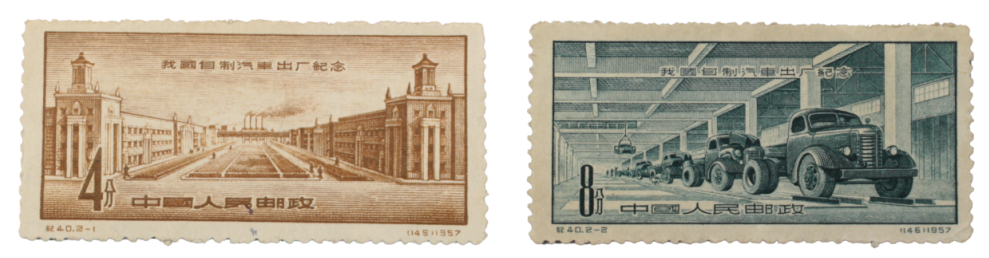
*本次藏品:纪40邮票汽车一套 *
典藏尺寸:23×47mm
以上藏品相关信息请与:四川尚亿拍卖有限公司联系。
For information about the above collections, please contact: Sichuan Jun Zailai Auction Group Co.